2026 World Cup · a model against the markets
An independent model against the markets, graded in public.
xResidual ran a forecasting model against Kalshi, Polymarket and the bookmaker consensus through all 104 matches of the 2026 World Cup, with every forecast committed before kickoff and eleven predictions about the markets locked in a timestamped commit. The headline result is the one I would least like: the market was better calibrated than my model, and the draws my model missed were ones the market had already priced.
Correction, 18 September 2026
This site previously led with a cross-venue finding: that Polymarket prices a goal about 600 ms before Kalshi, with an 81% information share. That finding is withdrawn. Kalshi's price was read from a feed capped at one message a second, Polymarket's from its full order book, and a market with no lead at all, measured the same way, reproduces the result. Inverting the measurement recovers no systematic ordering between the venues. One pre-registered prediction, P6, moved from pass to inconclusive as a result. The results below do not rest on it, with one limit: the harvest ledger uses the same timing to decide which venue to treat as the follower, and its conclusion holds because both venues' books empty at a goal. Read the correction →
What's inside
The model, its forecasts, and how they were graded.
The one-page memo
The whole project on a single page: what the market priced better than my model, what the cross-venue gap is actually worth, and the headline I withdrew.
read →
Scorecard
Every pre-committed forecast, graded: accuracy and log-loss against the baseline, the v1→v2→v3 ladder, and the biggest surprises.
open →
Forecast board
The model's probability for every market, pre-committed and timestamped against the price, scored on closing-line value and calibration.
open →
Group stage
All 72 group games, called up front, then conditioned and graded as each resolved. Three model versions, forward only.
open →
Bracket
The simulated knockout path, format-aware from the group stage to the final.
open →
How it works
The model, de-vigging, calibration, and what the capture could and could not measure.
read →
Repository
All code, the forecast ledgers, the pre-registration committed before kickoff, and the findings log.
open →
The results
Eleven predictions committed before kickoff and graded in public after the final, and what the model learned from the market.
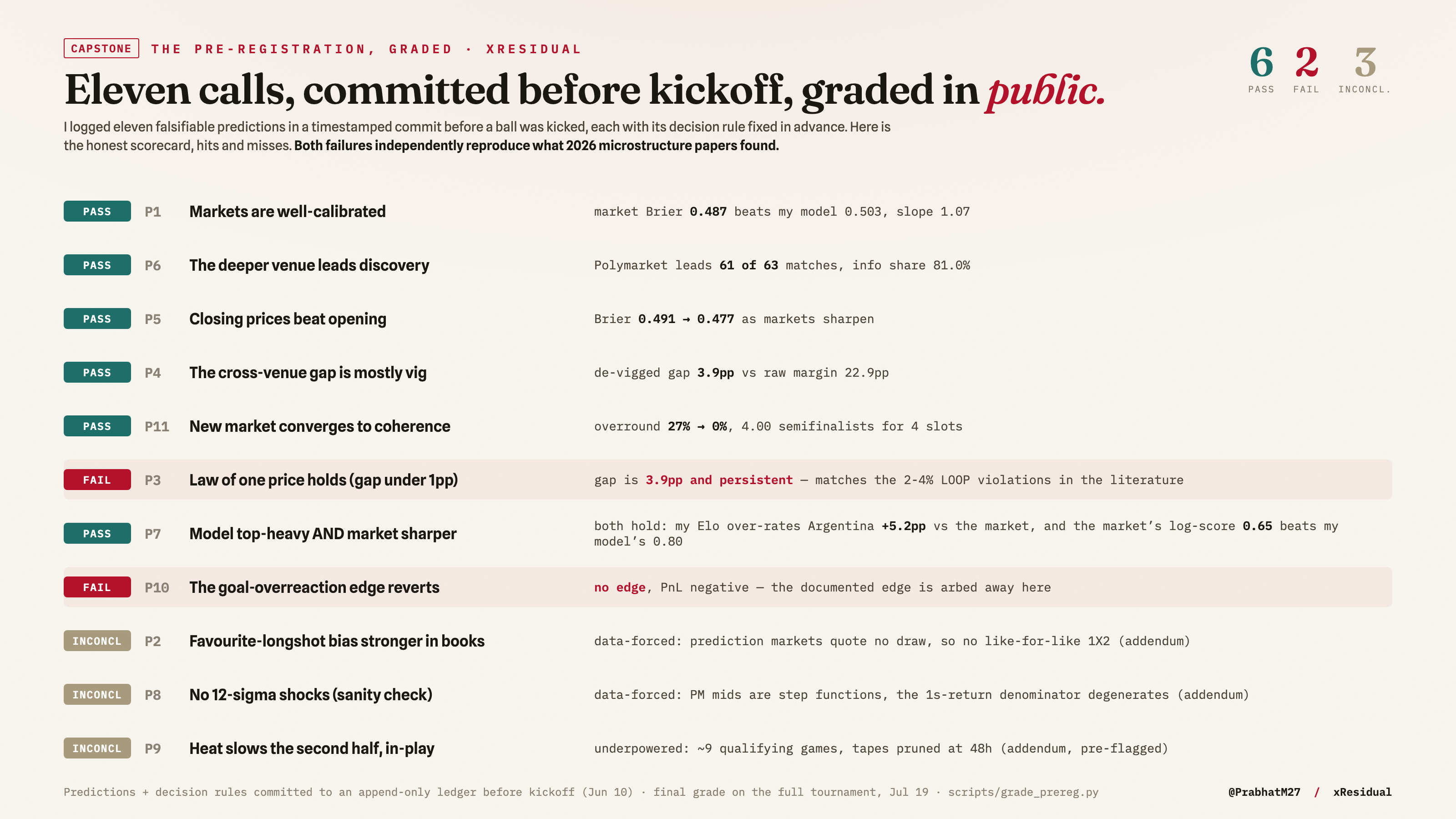
5 / 2 / 4pre-reg graded
Eleven calls, committed before kickoff, graded in the open. Five passed, two failed, and four are inconclusive for documented reasons, including the cross-venue prediction whose measurement could not see a lead.
5 pass · 2 fail · 4 inconclusive11 pre-registered
0.487market Brier
The market out-calibrated my model. On the 72 group games my model forecast before kickoff, the de-vigged market scored 0.487 against my 0.503, with a calibration slope of 1.07 against my 0.87: my probabilities ran too extreme. The Brier gap alone is not significant, so the claim is better calibrated, not beat the model.
Market slope 1.07my model 0.87
25.8%market, on realised draws
My errors were draws, and the market had already priced them. Seven of my eight worst calls were draws. On those calls the market had the outcome 2.7 points higher than I did, and on the realised draws in the 39 games with both a frozen forecast and a closing price (13 draws), it carried 25.8% against my 21.1%.
Market 25.8%my model 21.1%
0.17ppvenues agree
The two venues mostly agree on the event and differ on the price. De-vigged, Kalshi and Polymarket sat a median 0.17 points apart on the title race across the 20 days both books normalized. What separates them is cost: overround of 5.6% on Kalshi against 2.1% on Polymarket. The pre-registered version of this test (P3) still failed, because it was scored at the close as the field resolved.
Kalshi overround 5.6%Polymarket 2.1%
0harvestable, median match
A visible dislocation is mostly not a tradeable one. When a goal lands, the price moves a median 12.0¢. But both order books empty at the goal and refill in 3–4 seconds, so once you gate on what is actually resting there, the median match offers nothing to take. That uses the harshest measure of depth; read at the moment a follower could act, a minority of goals would have been takeable.
Book depth at the goal~0.5% of normal at the low point
$38the whole cross-venue arb
What the gap between the venues is actually worth. Walking both order books level by level, net of Kalshi's fee and discarding sub-tick flicker, the entire World Cup cross-venue arbitrage held about $4,855 of capacity for about $38 of locked profit — and the deepest book, the winner market, netted zero. An unfiltered version of the same walk had reported $427–$1,200; that was phantom depth on longshot books. A pre-tournament snapshot, with tooling since retired.
$38 lockedon $4,855 of capacity
+$148paper book, 46 positions
The paper book made money, and only part of it is skill. All 46 positions closed at +$148 on $1,452. The favourite–longshot lane on advance markets made +$181, and it is the one market where closing-line value — the skill signal that doesn't depend on who won — also backs the model: 74% of 46 directional calls drifted its way by the close. The reach-round lane's +$88 has no such support, so it counts as outcome, not edge. The two lanes flagged as edgeless before trading lost $117.
Advance-market CLV 74% positive+$181 in that lane
How it's built
An Elo-plus-squad-value goal model (Skellam goal difference, Dixon–Coles correction, a format-aware Monte Carlo from the group stage to the final) serves as an independent reference, not a competitor to the market: it exists to ask where model and market disagree and who turns out to be right. Two of its biases were found that way — squad-value blindness and inflated weak confederations — and corrected with fixes that validate out of sample. Model versions fork forward only, so no committed forecast was ever revised. The model rebuilds from public data on a clean clone and is covered by a test suite; the market layer came from a live capture whose raw data can't be redistributed. The stance throughout: the market is the subject, not the opponent.